Pre-competitive consortia
Pre-competitive consortia
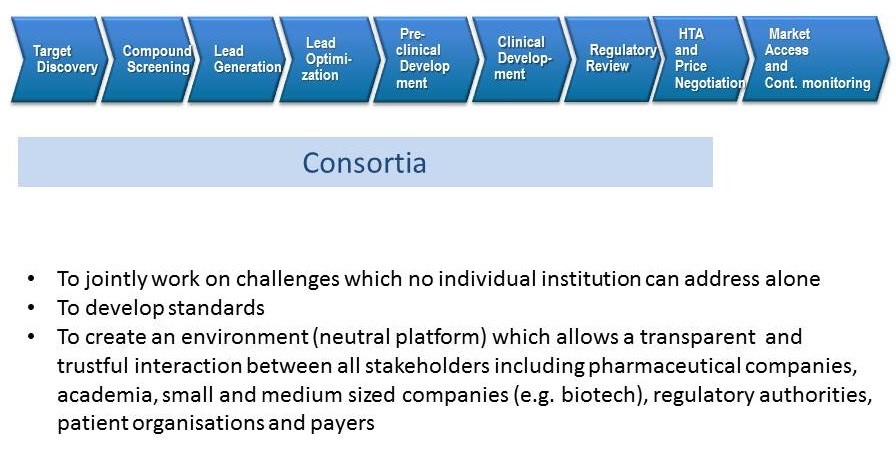
Figure 8: Pre-competitive consortia
Over the past few years there has been a shift in what is regarded as the ‘competitive field’ of pharmaceutical research. This has led to pharmaceutical companies taking part in ‘pre-competitive consortia’. These use the power of multi-stakeholder collaborations to address challenges which none of the partners could or would address alone. The participants of such consortia could include, in various combinations:
- Pharmaceutical companies;
- Biotech and Healthcare-IT companies;
- Academic research institutes;
- Patient organisations;
- Regulatory Authorities.
Example
One of the prime examples of this
concept is the Innovative Medicines Initiative (IMI). The IMI, a joint initiative of the European
Union and the European Federation of
Pharmaceutical Industries and Associations (EFPIA)[6] has the goal of making the medicines’ R&D process more efficient and effective, and addressing
major healthcare challenges for society and industry. With a total budget of
>€5 billion it is the largest public-private partnership in healthcare
R&D in the world. The currently funded projects involve several hundred
international partners. They are directed at:
- Solving issues related to target and biomarker identification and validation.
- Lead structure identification and characterisation technologies.
- Efficacy and safety of medicines.
- Clinical trial design.
- Relative effectiveness of treatments.
- Knowledge management.
- Education and training.
Sharing of data and knowledge from many stakeholders is another important approach to improve processes in R&D.
Finally, the topic of education and training (E&T) was addressed by several IMI projects aiming for an improvement of operational excellence along the whole value chain of medicines R&D.
Reaching out beyond the professionals working in medicines’ R&D, The European Patients’ Academy on Therapeutic Innovation (EUPATI was an IMI project from 2012 to 2017 and has since, after a bridging phase under the auspieces of the European Patients Forum (EPF), established itself as a Foundation). It provides education and training for all stakeholders, but foremost patients, on the processes of medicines R&D and patient engagement in these. A recent survey looked at the involvement of patients in IMI projects:
- Approximately two thirds of IMI projects currently have some form of patient participation. However, this is most commonly in the form of clinical trials or research where patient samples are required.
- Less commonly, patient organisations are part of the project consortium or members of ethical boards, etc.
- The most common reason for not involving patients is that it was not planned in the project scope. Small numbers of respondents note there is no clear benefit in involving patients, or that there are budgetary constraints.
The benefits of involving patients generally revolve around:
- The unique perspective patients can bring to a project.
- How patients can spread information more effectively, especially outside the scientific community.
- From the patient’s perspective, that they can become more knowledgeable and empowered to participate in various roles in the medicines development process.
- The fact that patients can influence decisions
and direct R&D to meet real patient needs.
- The burden on the patient in terms of finance, time and energy.
- Logistical, ethical and legal requirements associated with involving patients, particularly across countries.
- Language issues.
- Ensuring that the population is ‘representative’ when involving only a relatively small proportion of patients with a given condition.
The recommendations arising from this work include:
- Support involvement of patients in the early stages (beginning phase, consortium building, scoping) to ensure patient participation is an integral part of the project with adequate funding allocated up-front.
- Determine and formulate for different types of projects where patient input is most appropriate and beneficial. For example, in clinical trials or biomarker validation studies with rigid protocols, patients do not have much opportunity to provide input (except as ‘subjects’) once the study protocol has been defined.
- Provide training for researchers to understand the potential benefits of involving patients in their work and in which areas this can occur. This may be particularly valuable for projects that currently see patients only as ‘subjects’ either as participants in trials or as providing sample material.
- Ensure the financial and accounting barriers to patient participation are kept as low as possible, including understanding the limitations patient organisations face with regard to eligibility of expenses (VAT, ad hoc staff or consultants etc.).
- Ensure that non-patient project partners are aware of the potential special needs of patients, including limitations in travelling (when organising meetings).
- In areas where expertise among patients is lacking, provide training and support to patients to equip them to contribute meaningfully to research projects.
These recommendations, accepted by IMI JU (Joint Undertaking), can be applied to other projects of a similar nature.
In addition, it is important for the R&D communities to understand that the purpose of interaction and collaboration with patients is to explore a variety of patient perspectives and that representativeness is neither a purpose nor requirement. Collaborating with patient representatives or advocacy groups can inspire research questions, provide input to go/no-go decisions or input to solutions during the development phases, e.g. clinical trial design or informed consent form information. Collaboration with patients at this stage is therefore different in purpose and format from collecting representative data for a clinical trial research question. This must be answered only by collecting and analysing data derived from a representative group of trial participants.