Individual projects
Individual Projects
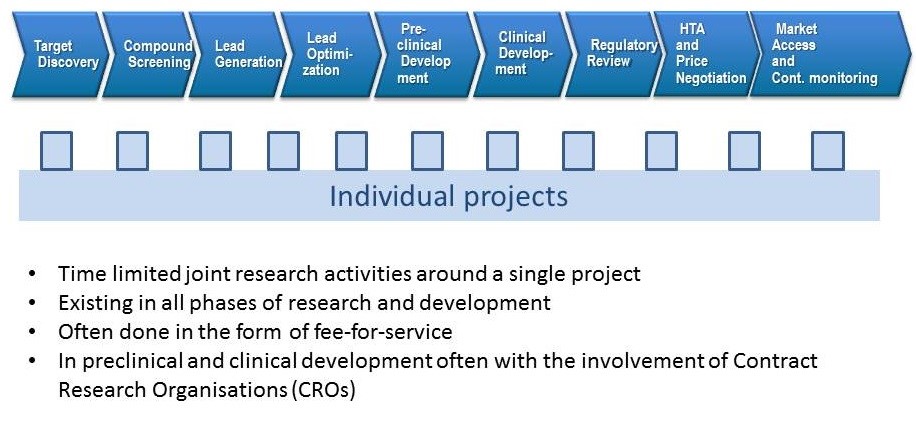
Figure 7:
Individual projects.
Pharmaceutical companies partner with other stakeholders around individual projects all along the value chain. This has been used for many years as the typical model of interaction.
- In early research, the partners are often academic institutions and smaller companies (e.g., biotechs) but can also be patient organisations
- In clinical development, partners are mostly major hospitals and academic clinical research institutions and increasingly patient organisations.
The interaction can be a joint
research project following pre-defined terms, e.g., for sharing of risk and benefit. But often the collaboration is more a
‘fee-for-service’ relationship where the project is defined by the
pharmaceutical company and the partner is paid for its contribution. In
pre-clinical and especially in clinical development, very often professional
organisations, known as Contract Research Organisations (CROs), act as a
partner for the pharmaceutical company. They coordinate, for example, the
clinical trial activities.
A success story of patient
involvement in projects at an early stage of medicines development is given
below.
Genethon is a non-profit biotherapy R&D organisation. It is created and funded by the Association
Française contre les Myopathies (AFM-Telethon), a French association that supports patients and their families, and
which organises the country’s annual ‘Telethon’ (a televised fundraising
event). Its mission is to ensure that patients have access to innovative
treatments. It does this by designing gene therapy products for rare diseases, and ensuring that they go
through non-clinical and clinical development to eventually be produced. It is
an integrated R&D centre ensuring ‘translational development’ from research
up to clinical validation, including biomanufacturing
according to pharmaceutical standards. In other words, it turns early
innovations into new health products that can then be developed further by the
pharmaceutical industry.
In clinical development
projects, patients act as participants in clinical trials and/or ethics
committees. In recent years more and more patients take a more pro-active or
strategic role, for example in supporting the companies in the discussion of
unmet needs or development of clinical trial design and conduct.